Back to blog
Blog
Choosing a booking system for your club: 7 questions before you decide
Dispoly Team
End the booking chaos today.
30-day free trial. No credit card required.
Blog
30-day free trial. No credit card required.
Most booking systems don't fail because a feature is missing. They fail because four months in, people are asking in the group chat again: two people forgot the password and one never created an account.
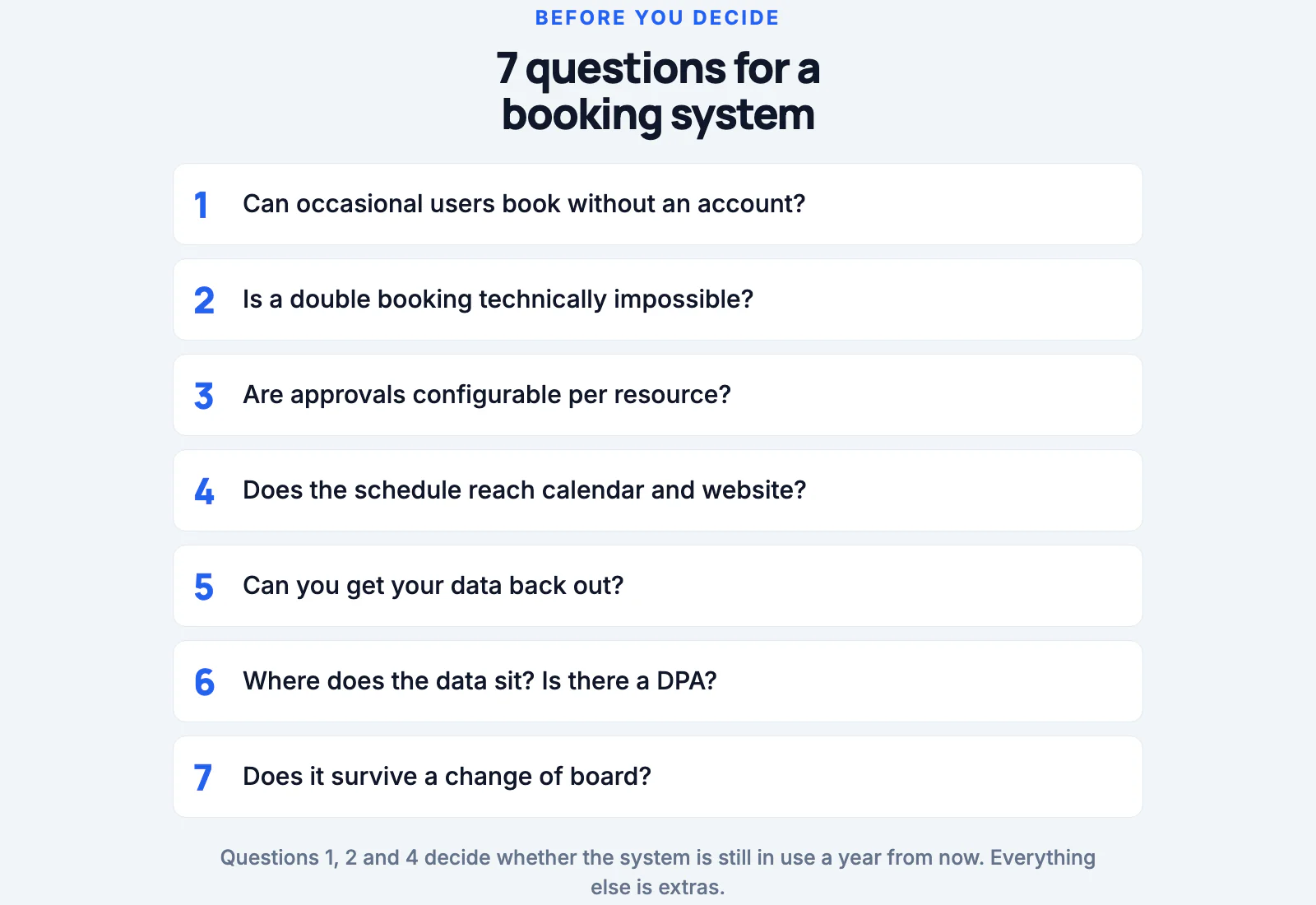
The questions that prevent that are rarely in a feature list. Here are seven.
Honest answer: not every club needs software.
If you have one resource, meaning one room, one vehicle or one piece of equipment, and three people look after it who already use the same calendar, then a shared calendar is enough. It costs nothing and everyone knows how it works.
It gets interesting as soon as one of these comes into play:
If two or more of those apply, a system is worth a look. But then go in with these seven questions.
This is the most important question, and it is almost always overlooked.
For the board, an account is no problem. For the member who needs the trailer twice a year, the account is the hurdle, and that is where they give up. So they call instead, and you are back where you started.
Put it concretely: can someone who has never heard of your system open a link, see what's free and book? Without registering, without an app, without a password?
If the answer is no, the system will only ever be used by the people who maintain it anyway.
"The system shows the slot as taken" and "the system refuses the second booking" are two different promises.
With a shared calendar or a spreadsheet, the double booking is possible at any time, it just surfaces later. In the worst case only when both of them are standing at the door.
A booking system should catch the conflict on submit and refuse the second booking, even when two people hit submit at the same moment.
Test it: what happens if you book the same period twice? If both go through, you have bought a prettier spreadsheet, nothing more. Avoiding double bookings covers why that is the heart of the matter.
Some resources anyone can take, others not. The projector is harmless, the club minibus isn't, the circular saw certainly isn't.
A decent system lets you decide that per resource, not just globally. Otherwise you either approve every booking, which is work, or none of them, which is risky.
Also check what happens after an approval: does the person who asked get told automatically, or do you still have to write an email? If it's the latter, you have only moved the work somewhere else.
A system you have to log into just to check something doesn't get used. People look at their own calendar and at the club website, not at yet another portal.
So watch for two things:
Both sound like details, and in practice both decide whether the system becomes part of everyday life.
Nobody asks this before deciding, and everybody asks it afterwards.
Settle it beforehand: do you get your resources and bookings back out as CSV or Excel, in a format another system can read?
The way in matters just as much. If you can't upload your list and have to retype everything, the start costs you a weekend. From Excel to a booking calendar describes what a move should look like.
Bookings produce names, email addresses and sometimes notes. That is personal data, even when it's only a projector being reserved.
The liability question is answered quickly: you are responsible. The vendor processes the data on your behalf, which is what the data processing agreement is for. It sets out what the vendor may and may not do with the data. It is still your club that answers to your members and guests.
Settle this before you decide:
The last point usually gets too coarse an answer. What matters is not whether anything is measured but how: a service that sets cookies, or otherwise stores or reads anything on the visitor's device, needs consent under Section 25(1) TDDDG, the German implementation of the EU ePrivacy rules, and that means a banner. Measurement without cookies, which stores nothing on the device, works without one. Either way you need a legal basis, meaning a reason you are allowed to collect the data at all, and an entry in your privacy notice.
What else matters with booking data, from collecting less to the question of who gets to see which bookings, is in GDPR and booking data.
Volunteer work means turnover. In two years someone else will be doing this, and they won't ask the same questions you are asking today.
In practice that means:
A system that only the current secretary understands is good for exactly as long as that secretary stays.
Price matters, but it comes last here on purpose. Pay less attention to the monthly figure than to the limits behind it:
And before you decide, test with your real resources, not with sample data. Only then do you find out whether the structure fits your club.
If you only want to remember three questions:
Answer those three with yes and you will still be using the system in a year. Everything else is extras.
How Dispoly answers these questions is on the solutions page for clubs. And if you finish reading and conclude that a shared calendar is enough for you, that is a good decision too.
Trying it costs nothing: no contract, no setup fee, 30 days free.